 |
| Own art (@DraysDump) |
"The family of Accipitriformes (Accipitridae) includes most diurnal birds of prey. Their size ranges from medium to very large, and they are either hunters or scavengers. They have claws and beaks that are hook-shaped, and broad wings that allow them to glide for longer periods of time."
Description:
It is also known as the black vulture, monk vulture and Eurasian black vulture.
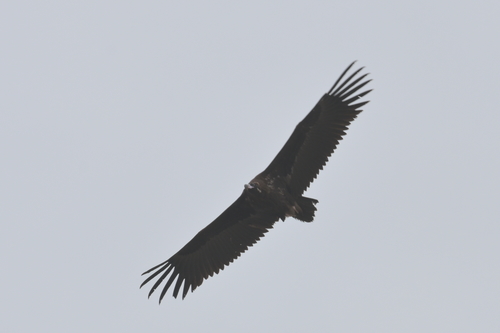
It is one of the only four species of vultures found in Europe, alongside the Eurasian griffon vulture, the Egyptian vulture, and the Bearded vulture. It is larger than the Eurasian griffon vulture, with much darker plumage, more rectangular wings, and a slightly pointed tail.
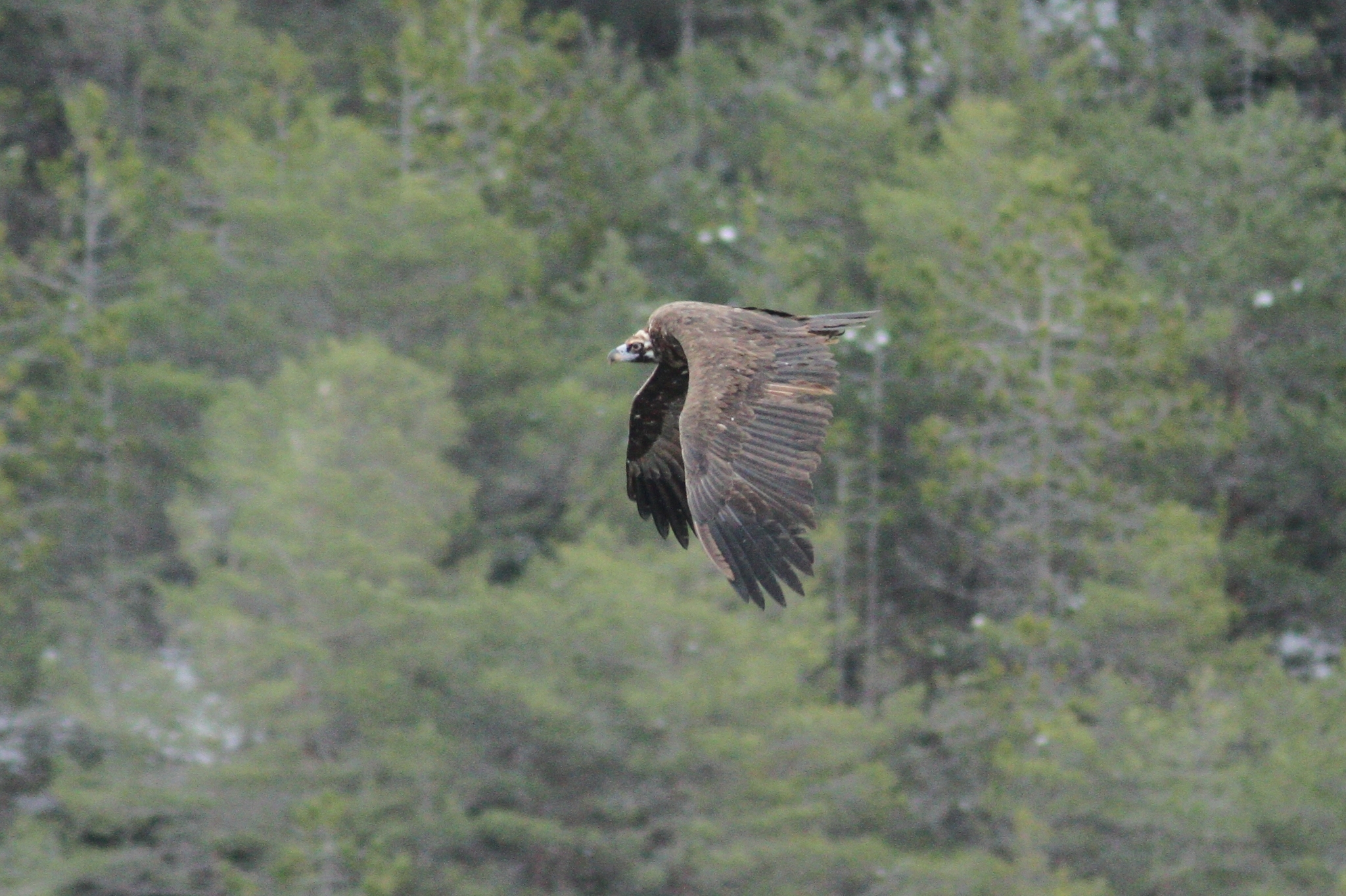
Not to be confused with the American black vulture (Coragyps atratus), as they belong to a different species and family. The black vulture's plumage is predominantly black, with dark brown feathers on the back. The neck and head are also black, and instead of feathers, they have black down in these areas. Their beak is light gray, with a gradient towards black at the tip. There is no difference in plumage between males and females, so sexing must be done by analysis. Juveniles have darker plumage than adult specimens.
Like most vultures, the black vulture is a glider, which means it does not usually flap its wings to fly.
About the species:
- Reproduction and behaviour:
Black vulture pairs are monogamous and remain together year after year. Each year, the breeding pair will return to the same nest that they used in previous years. Whenever they are at the nest, one of the two adults stays in it, without leaving.
- Clutch size: 1 egg
- Incubation period: 50 - 62 days
- Mating season: february - march
- Nesting season: may
- Sexual maturity: generally occurs at around 4-5 years of age. However, pairs can form as early as 2 years of age.
- Life expectancy: 19 - 40 years (there isn't much information)
- Diet and interaction with the enviroment:
Black vultures are scavenger animals. They always try to reach the carcass before other scavengers to feed almost exclusively on the muscular tissue of the prey, and they usually do not consume the viscera. They also hunt small animals in flight such as squirrels, rabbits, hares, and lizards.
They look for their prey in terrains such as steppes, grasslands, open forests, riverbanks, and mountains.
- Conservation status: NT (Near Threatened)

Habitat:
The black vulture is mainly found in Asia, ranging from Turkey and the Caucasus to the Manchuria region of China. In Europe, it can be seen in Crimea, Greece, southwestern Iberian Peninsula, and on some Mediterranean islands. A population has been reintroduced in France. During winter, it can be observed in the Nile Valley, Palestine, and Korea.
Their preferred habitats are rocky cliffs and gorges with vegetation. Typically, juvenile individuals leaving the nest are the ones thatWi migrate.

Breeding. Resident. Passage. Wintering area. Extinct. Reintroduced.
Physiognomic info:
- Height: 100 cm (3 ft 3 in) - 110 cm (3 ft 7 in)
- Wingspan: 2.5 m (8 ft 2 in) - 3.1 m (10 ft 2 in)
- Weight: Males from 6.3 kg (14 lb) to 11.5 kg (25 lb). Females from de 7.5 kg (17 lb) to 14 kg (31 lb).
- Tail: 33 cm (1 ft 1 in) - 41 cm (1 ft 1 in)
- Tarsus: 12 cm (5 in) -14.6 cm (6 in)
Taxonomy:

Sound:

They are usually silent, generally only communicating with their offspring in the vicinity of their nest.
Gallery:
 |
| https://www.inaturalist.org/photos/199559959 |
 |
| https://www.inaturalist.org/photos/78543447 |
 |
| https://www.inaturalist.org/photos/254254075 |
Sources:
- Integrated Taxonomic Information System (ITIS)
- "de Juana Aranzana, E. (2016). Aves de España (3.a ed.). Lynx Edicions. (Original work published 2000)"
- Global Biodiversity Information Facility (GBIF)
- eBird
- "de Aves, B. (2021, 23 abril). Buitre Negro: características, hábitat, alimentación y más. Blog De Aves. https://blogdeaves.com/accipitridae/buitre-negro/ "
- " De SanoAK: Alexander Kürthy - Made with Natural Earth. Free vector and raster map data @ naturalearthdata.com. Range map from BirdLife International 2018. Aegypius monachus. The IUCN Red List of Threatened Species 2018: e.T22695231A131935194. https://dx.doi.org/10.2305/IUCN.UK.2018-2.RLTS.T22695231A131935194.en. Downloaded on 29 March 2019 as visual indicator of distribution., CC BY-SA 4.0, https://commons.wikimedia.org/w/index.php?curid=77638583 "
- "colaboradores de Wikipedia. (2023). Aegypius monachus. Wikipedia, la enciclopedia libre. https://es.wikipedia.org/wiki/Aegypius_monachus "


No hay comentarios:
Publicar un comentario